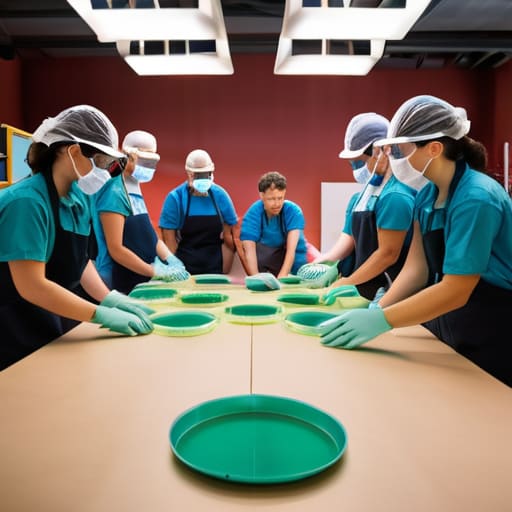
I remember standing in a science lab during a Tuesday period five, smelling that sharp, metallic tang of spilled chemicals and hearing the low-frequency hum of thirty teenagers who had collectively decided that rules were merely suggestions. I had a forty-page health and safety binder sitting on my desk, thick enough to use as a doorstop, yet it hadn’t done a single thing to stop a Year 9 student from eyeing a Bunsen burner like it was a toy. We spend so much time obsessing over these polished, theoretical manuals that completely ignore the reality of a crowded room. If you’re looking for a lecture on how to teach practical subjects safely by reading a checklist designed by someone who hasn’t stepped foot in a classroom since 1994, you’ve come to the wrong place.
I’m not here to give you more paperwork to file or more “best practice” buzzwords that fall apart the moment a student starts acting up. Instead, I want to talk about the actual mechanics of keeping a room under control when things get messy. I’m going to share the hard-won, slightly cynical, but ultimately effective ways to manage risk when you’re tired, understaffed, and dealing with a class that has zero interest in following instructions. This is about what works when the chaos is real.
Table of Contents
- Classroom Risk Assessment Protocols for the Tired Teacher
- Student Safety During Demonstrations When You Lack Eyes in the Back
- Five Ways to Keep the Room Standing When You’re Too Tired for a Crisis
- The Reality Check: Three Things to Carry Out of the Lab
- The Myth of the Perfect Safety Audit
- The Reality of the Safety Net
Classroom Risk Assessment Protocols for the Tired Teacher
Look, I know what the compliance folder says. It’s a thick, laminated binder filled with classroom risk assessment protocols that look great in a folder but feel entirely disconnected from the reality of a Tuesday afternoon when the heating has gone off and half the class is vibrating with restless energy. When you’re exhausted, the last thing you want to do is play detective with a checklist. But here is the truth: a formal risk assessment isn’t about satisfying an inspector; it’s about building a mental map of where the danger lives so you don’t have to think about it when things get loud.
Instead of trying to memorise a hundred different hands-on learning safety guidelines, focus on the “high-traffic” hazards. I’ve learned that most accidents don’t happen during the complex stuff; they happen during the transitions. If you can control the movement between the desks and the equipment, you’ve won eighty percent of the battle. Don’t aim for perfection—aim for predictability. If the students know exactly how a tool is handled before they even touch it, you aren’t just managing a classroom; you’re managing the chaos.
Student Safety During Demonstrations When You Lack Eyes in the Back
The problem with most official guidance on student safety during demonstrations is that it assumes you are a polymath with a swivel chair and a third eye. It suggests you stand at the front, deliver a flawless lecture, and then somehow monitor thirty different sets of hands simultaneously. In reality, you are usually standing there trying to keep your own voice above the hum of a ventilation fan or the scraping of chairs, praying that no one is testing the structural integrity of a piece of equipment behind your back.
If you want to actually manage the risk, you have to stop treating the demonstration as a performance and start treating it as a controlled transition. I’ve learned that the most effective workshop safety supervision techniques aren’t about more rules; they are about the “eyes on” contract. Before you even touch a tool, you establish that if your eyes are on the demonstration, their eyes are on you—no exceptions. You don’t just talk through the steps; you make them repeat the specific hazard back to you. It’s not about being a drill sergeant; it’s about ensuring that when you turn around to grab a different piece of kit, the room hasn’t turned into a free-for-all.
Five Ways to Keep the Room Standing When You’re Too Tired for a Crisis
- Stop treating your risk assessment like a legal document and start treating it like a map. If the paperwork is twenty pages long, you won’t look at it when a Year 9 is holding a scalpel like a spoon; you need a one-page ‘cheat sheet’ that actually highlights the three things that will actually cause a trip to the medical room.
- The ‘Golden Rule’ of demonstrations: if you are standing at the front showing something, every single student must have their hands visible and flat on the desk. If you see a hand disappear under a table or go into a pocket, the demonstration stops immediately. You can’t manage the chaos if you can’t see the hands.
- Build ‘Safety Buffers’ into your lesson timing. We’ve all been there—it’s five minutes to the bell, the practical is half-finished, and everyone is rushing to clean up. That is exactly when someone gets a nick or a spill. Teach them that the last ten minutes are for ‘controlled shutdown,’ not a frantic scramble to hide the evidence of a messy lesson.
- Don’t trust the ‘quiet’ kids. In my experience, the students who are causing the most trouble are often the ones making the most noise, but the ones who are actually going to hurt themselves are the ones who think they’ve mastered the equipment and start experimenting on their own. Watch the ‘confident’ ones just as closely as the ‘disruptive’ ones.
- Make the kit your responsibility, not theirs—at least initially. I don’t care what the latest ‘student-led autonomy’ initiative says; if you’re in a high-risk practical, you don’t hand out the dangerous bits until you’ve seen that the seating plan is working and the noise level is manageable. You don’t hand out keys to a car before you’ve checked if the driver has a license.
The Reality Check: Three Things to Carry Out of the Lab
Stop trying to write a perfect risk assessment for a scenario that will never happen; instead, focus on the three most likely ways a student will actually mess up when they’re bored or distracted, and have a plan for just those.
If you can’t see every pair of hands during a demonstration, you aren’t teaching—you’re just hoping for the best, so stop the demo and move the kids into a formation where you can actually spot the person reaching for the wrong tool before they do it.
Safety isn’t a document in a folder; it’s the culture you build when you stop treating the rules like a chore and start treating them like the only thing standing between a productive lesson and a very long, very unpleasant meeting with the Headteacher.
The Myth of the Perfect Safety Audit
“We spend far too much time filling out colour-coded risk assessment forms that sit in a folder gathering dust, and not nearly enough time figuring out how to stop a Year 9 with a sudden burst of adrenaline from turning a controlled demonstration into a scene from a disaster movie.”
Ellery Mwangi-Selkirk
The Reality of the Safety Net
Look, I know the paperwork feels like a mountain you didn’t sign up to climb, but at the end of the day, safety isn’t about the perfect, pristine risk assessment sitting in a folder in the office. It’s about the small, gritty habits: the way you scan the room before you even pick up a tool, the way you position yourself so you aren’t turning your back on a group of Year 9s with too much energy and too little focus, and the way you simplify your demonstrations so they actually stick. We can’t control every variable, and we certainly can’t prevent every minor mishap, but we can build a culture of awareness that survives even when the lesson plan goes sideways and you’re running on nothing but lukewarm coffee.
Teaching practical subjects is a high-wire act, and some days it feels like we’re doing it without a net. But don’t let the fear of the “what ifs” paralyze the joy of the “look what I can do.” The goal isn’t to create a sterile, risk-free vacuum where nothing ever happens; it’s to provide a stable enough foundation so that real learning can actually take place. You are the most important piece of safety equipment in that room. Trust your instincts, watch your students, and remember that even on the most chaotic of Wednesdays, you are giving them the chance to master something real.

Author

Related Posts

Front-loading Planning Before Term Starts
I remember sitting in a windowless departmental meeting three years ago, staring at a colour-coded, multi-layered spreadsheet that promised to revolutionize our...
Read out all
Cutting Workload Without Cutting Quality
I remember sitting in a departmental meeting ten years ago, staring at a glossy, twenty-page handout on “holistic feedback loops” that promised...
Read out all
Supporting a Teacher in Their First Year
I remember sitting in a windowless meeting room during my second year, staring at a glossy, laminated “Induction Roadmap” that promised a...
Read out all
Cpd That Changes Practice Six Weeks Later
I remember sitting in a windowless staff room in 2014, staring at a glossy, thirty-slide presentation about “transformative pedagogical shifts” while my...
Read out all
Instructional Coaching in Fifteen Minute Cycles
I’ve sat through enough “professional development” sessions in drafty school halls to know the drill: a consultant with a polished PowerPoint tells...
Read out all
Observation for Development, Not Grading
I remember sitting in the staffroom during my third year as Head of Department, staring at a thirty-page observation rubric that felt...
Read out all